
Illinois
vignettes

Winnetka
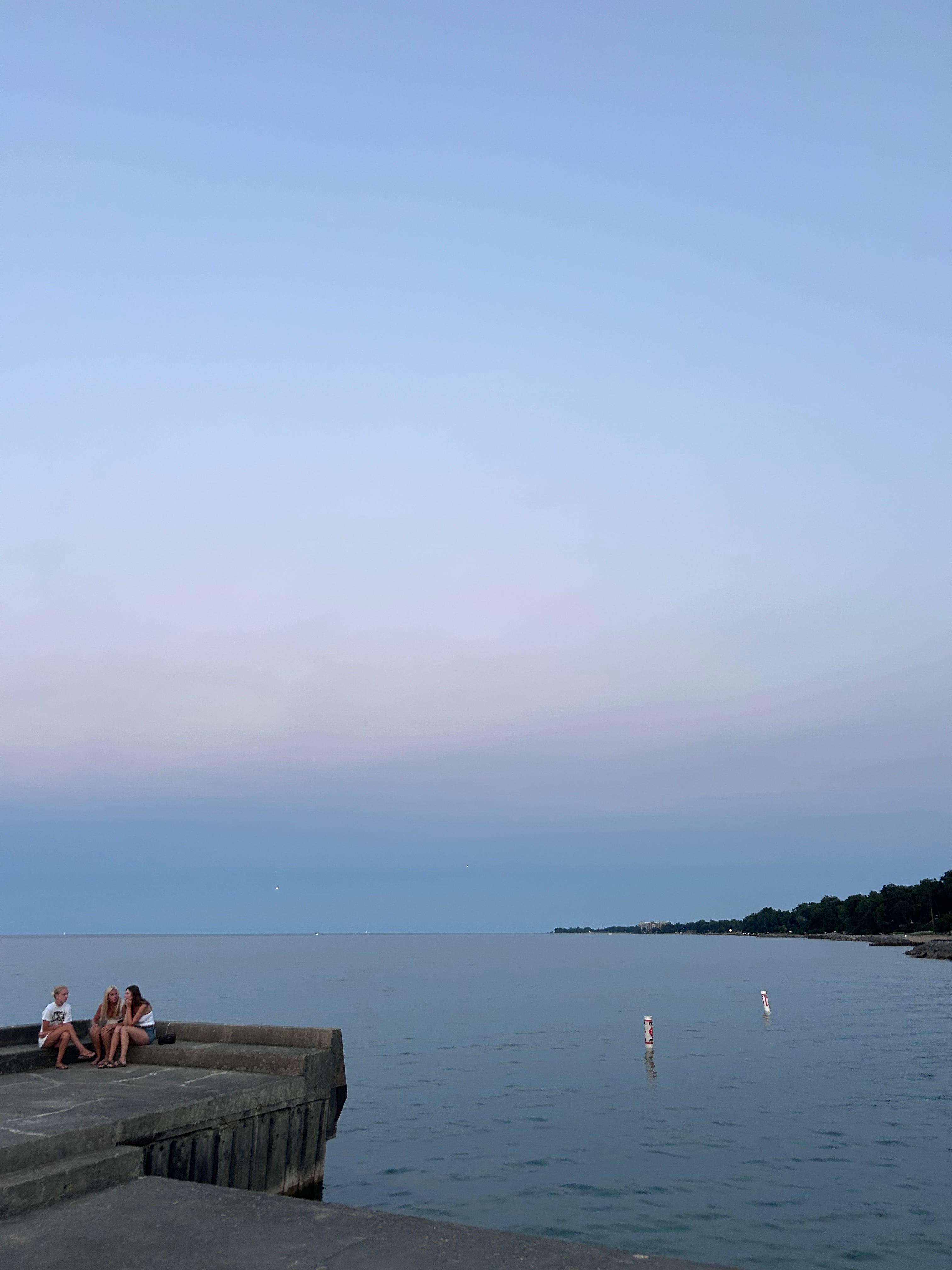
Having come from the sea, the lake is strange to me. A thin strip of sand, and over it, a great sweep of willows and pines. No white crust or scent of salt. The sky silent of bird cries.
They allow this little strip of land for public access at thirty dollars a day. To both sides the beach continues, but signs warn against trespassing. Private docks built of gathered rocks extend from where they connect to their quiet estates.
The boardwalk is littered with the slender, careless bodies of the local adolescents—salon blonde, Vineyard Vines, David Yurman. Sipping root beer or beer and playing Lucy Dacus from their phone speakers. I’m taking pictures of the blush-pink sunset over the lake, but increasingly my attention is drawn to them, the lords and ladies of Winnetka, inheritors of so much ease, an endlessly bountiful and increasingly rare way of life.
It makes me laugh, how they style themselves after the coastal New Englanders. The bundled hydrangeas just beginning their bloom, the swinging wooden signs, white hammocks, seashell windcatchers, blue and white striped linens. As if stepping into the neighborhoods of my childhood.
I can’t help wondering where this wealth comes from, shuttered behind topiary and wrought iron gates. One estate has a hill sweeping from the covered deck to the lake, half-scalped to allow for backyard golfing. Another has pillars like an institution and a set of wooden doors as its entry. One has hired a band for the night, amber light and music spilling from cracked windows. The smell of beer in the air, and the caterers, shadowed such that they are barely visible, moving new trays of food from their truck.
It makes me sick with desire for a while. I window-watch, imagining their lives from what I can see through rectangular panes. A young girl reads at a desk while her mother, slender, light hair in a low ponytail, irons a shirt. In the next room, a man—Father? Brother?—sits at a table. Or muted laughter from a dinner party, the fluted women’s voices and lower baritones of the men, laughs that punctuate the air like birdshot.
There are no streetlights. No one is outside—Everyone is shut up in their great houses.
*
Oak Park
She’s old, older than 63 should rightfully be. Her hearing is half gone. She dresses loudly and speaks without much care for manners, with the air of someone who, for her career, learned to ignore manners, which were too often in service of keeping her quiet. Yes, she says, she was a lawyer.
We wait for the rest of the story. It’s coming, we can almost fill in the gaps with what she tells us of her life. That she lives in River Forest, that beautiful, tree-lined neighborhood we walk to remind ourselves of what wealth can get you, those ivy-covered walls and hydrangea-shaded walkways. That she writes letters to the Theatre Editor at the New York Times. That she takes day-trips to New York to see her favorite plays—once, Robert Downey Jr. in his Broadway debut. She is an opera fan, her husband an orchestra-goer.
She was in employment law, UVA. Which side? Well, which do you think? One pays for a house in River Forest and early retirement. In-house at AT&T, she says, and smokes a pretend hookah. She laughs at herself to deflect. It almost works.
I leave dinner a little stunned, and with her phone number. She wants to ring a cowbell at the race I will run in a month. My boyfriend finds her house on Zillow immediately. Modest, relatively—1.7 million. Comfortably-sized. Retirement, I remind him.
If you can’t be an artist, be a patron. Absolution of all sins. I think about what it takes to buy a life like that, and whether I could do it. Whether I want it, truly. I can’t say. It is difficult not to want what you are surrounded by and yet can’t have.
*
Austin / West Loop
On a Thursday we run from Oak Park to West Loop. 8 miles on the dot. Our path is straight, following the Green Line all the way.
Fascinating, the way the neighborhoods change. The brick-and-cobble streets give way to flat, cracked pavement. The shade vanishes, as though the trees are shrinking back, withering into themselves. The detritus of warehouses, current and abandoned, and former life, houses sliding into their foundations. Endless, inescapable sun.
But no one bothers us as we run—not the kids sitting outside the convenience store, not the old men playing dominoes. No comments are made that I run only in a sports bra and shorts.
It’s the openness of everything that makes the difference. The wealthier a place gets, the more it closes off—with trees, with flower bushes, with grates and gates and long driveways. Here, the houses sit on the street, the grass is yellow and flattened, the trees have been cut or never planted to begin with.
The shift happens quick. The pavement turns dark and perfect, like hammered steel;. The buildings rise. The air sharpens. There is still the sense of warehouse land, everything too expansive, as though a rot is being forcibly kept out. But now the apartments go for $3,000, and the girls are wearing Miu Miu.
The shade vanishes, as though the trees are shrinking back, withering into themselves. The detritus of warehouses, current and abandoned, and former life, houses sliding into their foundations. Endless, inescapable sun. Peak