
Paris; diaries

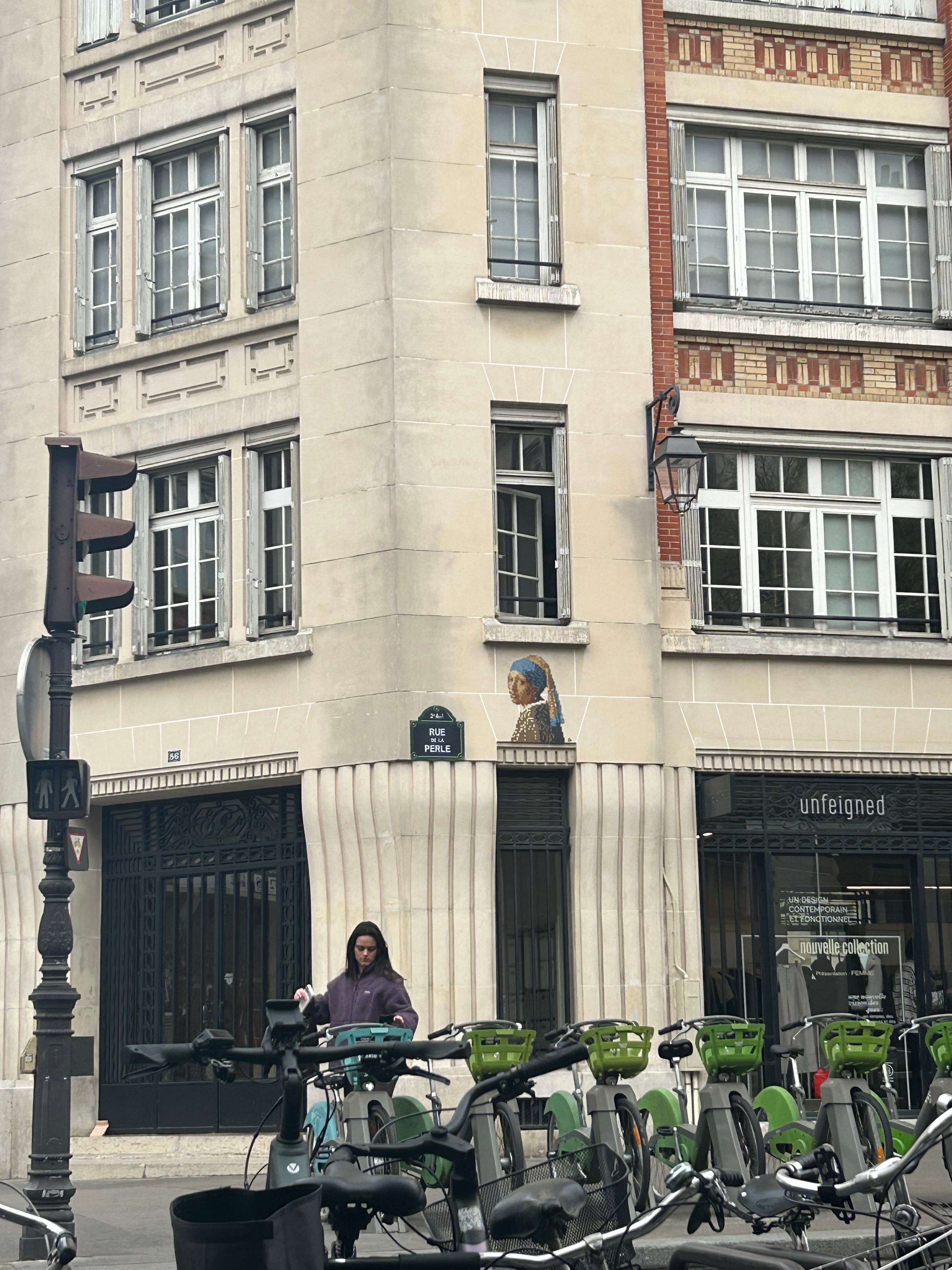
Rue la Perle. In mosaic, The Girl with a Pearl Earring, someone’s idea of a joke. A Parisian idea of a joke.
Zinc-topped sidewalk tables, each with its own ashtray. An enforced leisure in that the waiter, blonde, twenty-ish, will not take your order for almost half an hour. You should, like the others, take the time to smoke. In lieu of smoking, you listen and watch.
Above your head, a grated window to the kitchen. You can hear the hiss of oil in the pan, cracked eggs, tinny music from some radio. A shout, Hallelujah!, accented such that half the word goes missing. A drunken revelry that would be too early for this time of day anywhere else.
Three girls have taken seats a few tables over. They have artfully tousled buns and too-large clothes and no makeup except for colored lips. Cigarettes dangle between their thin fingers. They make a performance of lifting them to those bright lips, then purse, then the quick withdrawal.
An American photographer is trying to impress them. He is sixty or so, showing them pictures on the great camera dangling from his neck, trying to get them to follow his Instagram. He talks of his adventure in New York. Making art of the real world, real life. It doesn’t get more real than New York. Still, hard to make the mythos of New York attractive to Parisian teenagers. They smoke and smile at each other, half-mocking. He goes on gesturing, gesticulating.
Two older men watching this spectacle, drinking neat glasses of port. Nobody with anything better to do. A cloud goes over the sky, blots out the springtime sun. The girls go on smoking.
-
My home for these two days is tucked behind a cafe in the 1st Arrondissement and up four flights of the narrowest stairs I’ve ever climbed. The light fixtures are on a timer—once they are turned on, you have thirty seconds to ascend or descend the full length before being plunged into blackness.
My host is a Korean woman in her fifties, five foot nothing, with a charming Korean-French accent to her English. She arms me with a list of restaurants to go and not go, which coffee shops sell frozen food, and which supermarkets have the best fruit.
My room is so small that my head brushes the ceiling in places. It consists of a table with kettle and tea bags, a twin bed, a bathtub, a toilet, and a sink. In its whole it is no larger than my kitchen back home. The ceiling slopes with the roof, and half of it opens into a skylight. The sky through it is a great rectangle of blue and dashed-through grays, cut at intervals by the flight of crows and city sparrows.
I love it. I stare into the sky and feel absurdly close to it. I enjoy the sparseness of the place, life reduced down to its bare necessities, the cleanliness and removal of all unnecessary luxuries. I take my bath on my knees.
I love even the dangerous descent of the stairs, the great mirror on the second-floor landing where I take a few rushed pictures of myself before the timer runs out. I wear makeup as I haven’t in months, dress up in a way that feels ridiculous in my everyday life. I run the blowdry brush through my hair until it falls in silly waves. I feel my own silliness, taking so many pictures of myself, and think of the quote from Schitt’s Creek, the late great Catherine O’Hara: Take a thousand naked pictures of yourself now… Believe me, one day you will look at those photos with much kinder eyes and say, ‘Dear God, I was a beautiful thing!’
-
The same heels that took me around New York, that take me to and from work, now carry me through the streets of Paris. I like their little metronome, the way they strike and echo.
In my extravagance I book myself a dinner at a Michelin-starred restaurant, elevated French dining. I walk in at 7:30 only to be the second table in the whole place—the other table is occupied by a couple in their 70s. Early diners: the elderly and les Americains. I eat with appropriate shame.
I bring a book with me: Don DeLillo’s The Names. If I was strange for eating so early, not to mention alone, I am even stranger for this.
Plates descend and are removed with a clinical quickness. The waiter, once, apologizes for his poor English—it is so ridiculous a thing to apologize for that I laugh. I’ve arrived in this city armed with nothing but Bonjour and a tenuous grasp of schoolgirl Spanish. I should be apologizing to everyone I speak to.
When I finish dinner is when dinner begins for Paris. I watch lines slowly start to form at the openings of bistrots. Men and women smoke over amber beer glasses. They tip their heads back when they laugh, they push away loose curls of hair with graceful hands. Lamplight turns golden the contours of their faces and conversations.
I walk by, in love with my own loneliness. Above, a beam of light sweeps the city from the Eiffel Tower. I’m headed there to make the turn of the hour and see it sparkle. It is delicious to go through a new city like this, walking its streets and alleyways, wet from its rain. I pass the Arc du Triomph and watch the circles of cars as I once saw on Rick Steve’s. Everything looks like a dream.
I pass by a man with his dog. A tiny, playing thing, it runs circles around his legs and bites and the air and jumps, and he laughs and spins and splinters the night with his childish joy. It makes me smile the sort of smile that hurts.
On the banks of the Seine, already couples and birthday girls have gathered to take their pictures at the right time. A girl in a hijab poses for a picture; her face in the moonlight is so beautiful that I stare. Next to her, a man takes test shots of his wife, who is wearing a sleeveless red gown despite the chill.
Against the river’s black and silver, the lights from the tower look like a scattering of stars. The image shudders and severs as boats pass by. On the deck of a large cruise ship, an elderly couple smile nervously into a selfie. The husband checks the photo, smiles, kisses his wife’s hair.
At 11 on the dot, the Eiffel Tower sparkles. There is a ripple of gasps, even though this happens every hour, every night—hardly a phenomenon. Still, it takes the breath away, regardless of its simplicity, the obvious performance of it. The mythos is what moves you.
-
The Louvre is a ten-minute walk from my Airbnb. I wake early, dress myself in the gray dawn through the skylight. I watch myself in the mirror as I line my eyes, pat blush on the apples of my cheeks and eyelids. These days, it is so rare that I make myself up like this that the finished product feels not-me, or like an old self I shed a year ago. The working life is about efficiency. Most mornings, I do little more than comb my hair and rub out the dryness in my face with moisturizer. Spending thirty minutes curling my hair, another ten getting the angle of my eyeliner right—these are the luxuries of time.
The Louvre’s grandness is very different from the Eiffel Tower; it scorns attention where the Eiffel Tower seems to beg for it. It is so massive, so old, that it needs no embellishment.
The Mona Lisa, too, understates its own importance. A tiny thing affixed to the far wall. I see it over the heads of fifty other people.
A good story, told rightly, can make the smallest things great.
After, lunch in Bistrot Richelieu. I read in the sunlight through the wide bay windows and sip onion soup.
By writing this I create a record of my own memory, so that when even pictures fail to help me recall, I can read this and relive it.
The sun has moved well into the west by the time I make it to the Notre Dame. Sunlight paints the stone surface in gold filigree. The line moves quick; within minutes, I am in the hall. Some sort of ceremony or mass is occurring. Sixty-odd people sit in the pews, while we stand at the back and snap pictures and whisper.
It’s not grand, really—it looks more like the cathedrals in Pittsburgh than, say, la Sagrada Família. But I like its plainness, which speaks to its age, its original purpose. The brief minutes I am allowed to spend inside feel like I am intruding on a different world, some spirituality and shared belief I have no part in. Then I am outside again, among the tourists and the pigeons and the music of evening conversation.
Sunset; dinner in the bistrot next to Shakespeare and Co. A long line of girls in wool coats extends out of its door; girls eager to linger where a hundred famous writers have lingered.
There is a table of Americans in the bistrot. They speak at enough decibels to render any other conversation impossible. I find myself grimacing apologetically at the exasperated waiter, especially when they knock a glass of red wine into their entrees.
Dinner is a bread basket with salted butter, a flaky goat cheese tart with pesto, and a pair of creme brûlées. The bread is shockingly good. I tear at it, animal-like.
To my left is a French family celebrating someone’s birthday. They speak in low, fluted voices, and they send angry eyes at their American counterparts.
I leave full and happy; the waiter calls me “beautiful girl.”
Now the dregs of my last night in Paris. I extend it as long as possible. I walk to a famous cafe serving mountains of whipped cream with their hot chocolate, then on to a tapas bar, where I meet my former coworker. We laugh and sip at egg-themed cocktails, exhaling out someone else’s smoke with every other breath. It is an incandescent way to end a weekend. When at last I take the late train home, I can still feel the heat of happiness under my breastbone.
Such music in your language